

Earnings Strength
This month, equity markets have continued to show some wariness around valuations for semiconductor companies and other AI-related firms. Several factors appear to be contributing to these concerns, including ongoing tensions in the Middle East and their potential effect on energy prices, as well as the continued rise in capital expenditures by large technology companies.
The pressure on stocks tied to these concerns has largely obscured the fact that the early slate of large-cap earnings reports has, by and large, been strong. The blended earnings growth rate for this subset of companies in the second quarter stands at 39.6%, with revenue growth of 12.9%.¹ If sustained, that level of earnings growth would represent the highest year-over-year earnings growth rate since the third quarter of 2021.² Reported profit margins have also been very healthy. Although Alphabet’s results are having an outsized impact on the averages, the blended net profit margin reported so far, 15.7%, remains encouraging and is outpacing analyst expectations.³ This strength has surprised to the upside, with 85.2% of companies that have reported so far beating forecasts.⁴
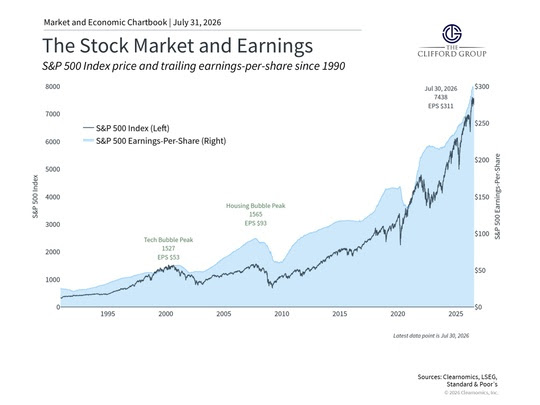
Continued earnings strength is a critical component of equity performance, and forward earnings forecasts remain constructive. Current estimates project average earnings per share of $407.26 for 2027 and $459.33 for 2028, up from $352.40 in 2026.⁵ In both domestic and international markets, earnings growth has been driven in large part by capital flows into AI and energy. Estimates suggest that these two areas of investment are driving 80% of emerging markets earnings growth, 60% of Japanese earnings growth, and 50% of earnings growth in the U.S.⁶ This trend continues to be an important market driver, with expectations for further growth in 2027 and beyond.
The Macroeconomic Picture
Earnings forecasts remain supported by solid macroeconomic results. Although GDP growth slowed in the second quarter, the underlying details were more encouraging.⁷ Real final sales to private domestic purchasers increased 3.9%, compared with 1.7% in the first quarter, while consumer spending rose at a 3.2% pace, up from 0.5% in the first quarter.⁸ The rebound in consumer spending was particularly notable, and if sustained, should continue to support corporate earnings.
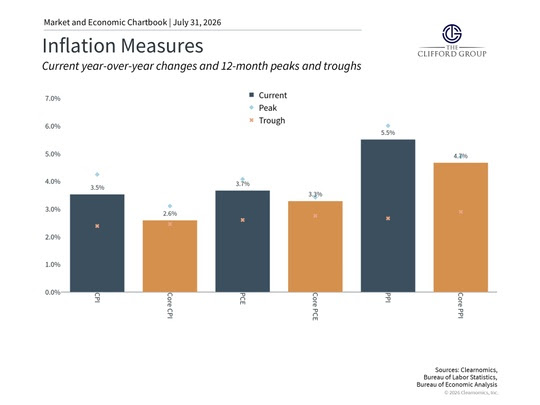
Inflation concerns remained a key market focus over the past month. The FOMC, under Chairman Warsh, voted 9-3 on July 29 to leave interest rates unchanged.⁹ A more favorable CPI inflation reading earlier in the month, which showed the consumer price index falling 0.4%, gave the committee room to avoid a rate increase for the time being.¹⁰ The decision created some volatility in both equity and bond markets. Ten- and thirty-year Treasury yields rose quickly on concerns that inflation could remain persistent, with the thirty-year yield reaching its highest level since 2007.¹¹
Strong earnings from Microsoft, followed by a softer PCE inflation reading, lifted equity markets on July 30, but Treasury yields remained elevated in the wake of the Fed decision. The FOMC is next scheduled to meet on September 15 and 16. In the interim, economic data releases may continue to create volatility as market participants assess the likely path of the federal funds rate.
The Evolution of the AI Market
Over the past few weeks, open-weight AI models have become a more relevant debate in financial markets after years of being discussed primarily as a regulatory, security, and philosophical issue. Open-weight models are large language models that can be downloaded by end users and customized locally for specific tasks. These offerings have proliferated in Chinese AI labs but remain fairly limited in the United States, where major AI companies such as Anthropic have argued that they can pose severe cybersecurity risks.¹²
Earlier this month, China’s Moonshot AI released its Kimi K3 model as an open-weight model, surprising many observers with how close its performance appeared to be to some recent public U.S. models from OpenAI and Anthropic.¹³ This development prompted some analysts to estimate that Chinese labs are now roughly six to nine months behind those in the United States.¹⁴
The Kimi K3 episode unsettled investors for reasons beyond performance alone. In theory, open-weight models could offer a more cost-effective option for some enterprise AI customers. If a company downloads an open-weight model and tailors it for specific tasks, its primary cost, aside from the technical expertise needed to customize and run the model, would be the computing power required to operate it, either through its own infrastructure or through services provided by the company that produced the model. In turn, this could reduce revenue opportunities for large language model companies that operate closed systems and charge recurring fees.¹⁵
Open-weight models are seeing increased use in the United States for specific tasks and circumstances, particularly those that do not require the most advanced model available. Earlier this month, it was reported that Hugging Face used a Chinese open-weight model to restore its cybersecurity after OpenAI models penetrated its network.¹⁶
Open-weight models are likely to have a place in the market. However, closed models, and the companies that produce them, may continue to hold competitive advantages in driving technological advancement because they generate more cash flow from their products. That cash flow can be reinvested into model development, infrastructure, and distribution, which may support continued gains in model capabilities. Closed-model systems also remain the primary solution for consumer use cases, where tailoring an open-weight model would be cumbersome for most users. To this end, Microsoft announced this week that its 365 Copilot product had reached more than 30 million paid seats.¹⁷
Regardless of the open-weight versus closed-model debate, continued growth in AI deployment and usage continues to drive demand across the AI supply chain, including data centers, chip suppliers, power infrastructure, and related services. We remain constructive on a broad spectrum of companies focused on addressing these needs, while also recognizing that volatility in these areas is a natural development given elevated spending levels, high expectations, and valuation sensitivity. This underscores the importance of maintaining exposure to the AI ecosystem while staying broadly diversified, as the long-term opportunity remains compelling but is likely to unfold unevenly across companies, sectors, and market cycles.
Citations
- Dhillon, T. S&P 500 Earnings Scorecard. LSEG I/B/E/S, July 29, 2026.
- Butters, J. Alphabet Drives S&P 500 Earnings Growth to Highest Level Since 2021 on Valuation Gains. FactSet, July 2026.
- Butters, J. S&P 500 Reporting Highest Net Profit Margin in More Than 15 Years. FactSet, July 2026.
- Dhillon, T. S&P 500 Earnings Scorecard. LSEG I/B/E/S, July 29, 2026.
- Ibid.
- Santos, G. What’s Behind the Surge in Global Earnings Growth? J.P. Morgan Asset Management, July 15, 2026.
- U.S. Bureau of Economic Analysis. GDP (Advance Estimate), 2nd Quarter 2026. U.S. Bureau of Economic Analysis, July 30, 2026.
- Torry, H. U.S. Economic Growth Slowed to 1.5% in Second Quarter. The Wall Street Journal, July 30, 2026.
- Timiraos, N. Fed Holds Rates Steady But Three Officials Voted for Increase. The Wall Street Journal, July 29, 2026.
- U.S. Bureau of Labor Statistics. Consumer Price Index Summary: June 2026. U.S. Bureau of Labor Statistics, July 14, 2026.
- Brettell, K. Microsoft Rally Lifts Stocks, 30-Year Treasury Yield Hits 19-Year Peak. Reuters, July 30, 2026.
- Amodei, D. Our Position on Open-Weights Models. Anthropic, July 27, 2026.
- Qu, T., and Huang, R. China’s Moonshot AI Releases Model to Challenge Top U.S. Systems. The Wall Street Journal, July 17, 2026.
- Ibid.
- Eastwood, B. AI Open Models Have Benefits. So Why Aren’t They More Widely Used? MIT Sloan School of Management, January 20, 2026.
- Perrigo, B. The OpenAI Hack Is Fueling a New Fight Over Open-Source AI. Time, July 28, 2026.
- Gardizy, A. Microsoft Profits Jump 31% as Azure Cloud Sales Surpass $100 Billion. The Wall Street Journal, July 29, 2026.
Important Information
The Clifford Group LLC (“The Clifford Group”) is a registered investment advisor. Advisory services are only offered to clients or prospective clients where The Clifford Group and its representatives are properly licensed or exempt from licensure. The information provided is for educational and informational purposes only and does not constitute investment advice and it should not be relied on as such. It should not be considered a solicitation to buy or an offer to sell a security. It does not take into account any investor’s particular investment objectives, strategies, tax status or investment horizon. You should consult your attorney or tax advisor. The views expressed in this commentary are subject to change based on market and other conditions. These documents may contain certain statements that may be deemed forward looking statements. Please note that any such statements are not guarantees of any future performance and actual results or developments may differ materially from those projected. Any projections, market outlooks, or estimates are based upon certain assumptions and should not be construed as indicative of actual events that will occur. All information has been obtained from sources believed to be reliable, but its accuracy is not guaranteed. There is no representation or warranty as to the current accuracy, reliability, or completeness of, nor liability for, decisions based on such information and it should not be relied on as such.
The information contained above is for illustrative purposes only.
For additional information, please visit our website at www.thecliffordgrp.com.
Risk Disclosure
No investment strategy or risk management technique can guarantee returns or eliminate risk in any market environment.
All investments include a risk of loss that clients should be prepared to bear. The principal risks of The Clifford Group strategies are disclosed in the publicly available Form ADV Part 2A.
Diversification does not ensure a profit or guarantee against loss. Risk associated with equity investing include stock values which may fluctuate in response to the activities of individual companies and general market and economic conditions. The major risks associated with investing in the natural resources sector, including large price volatility due to non-diversification and concentration in natural resources companies.
Performance Disclosure
Index returns are unmanaged and do not reflect the deduction of any fees or expenses. Index returns reflect all items of income, gain and loss and the reinvestment of dividends and other income. You cannot invest directly in an Index.
For additional information, please visit our website at
www.thecliffordgrp.com.