

February Market Insights
Market Movement
Since the start of 2025, we have seen more frequent days of volatility in the market. We believe that this was bound to happen as a result of the macro-economic trends of the last two years, relatively high valuations in certain areas of the market, and a changing political landscape. Two events in the last few weeks stand out for the volatility that followed.
When the news broke that a Chinese AI company, DeepSeek, had developed a large language model comparable in some ways to popular American LLMs for a fraction of the cost, semiconductor and energy stocks came under significant pressure. We believe this was largely an overreaction, though the DeepSeek event does give us some interesting insights. DeepSeek, in their announcement, claimed that training costs for the model totaled around $6 million compared to the roughly $500 million in expenses for popular American models.1 This difference in computing costs sparked the plunge in AI supporting stocks, but there are reasons to believe that the DeepSeek number does not paint an accurate picture of what went into the model. First of all, DeepSeek has not reported the costs of previous models, which likely were used to develop R1. Second, there is evidence that DeepSeek may have “distilled” from OpenAI and other American models in order to build R1.2 Distillation is a process by which a large, pre-established, model is used to train a smaller model, allowing the smaller model to learn with lesser computational power. Microsoft security researchers reportedly observed large amounts of data being exfiltrated from OpenAI in the fall of 2024 and suspected it was done by DeepSeek. OpenAI is investigating the event.3
While the true gap in training costs may not have been as significant as reported, there certainly was innovation in the DeepSeek model. We see a significant amount of upside in this innovation for both American AI companies and for the prospect of end-user AI adoption. It is vital to remember that LLMs represent just the beginning of what AI can achieve and DeepSeek did not provide an advancement in end-use capabilities.4 In fact, the real competitive advantage for American AI companies may be in the next generation production of LLMs, when recent export controls on hardware to China prevent companies like DeepSeek from amassing the same kind of processing capability.5 DeepSeek’s chief innovation, reducing the cost and increasing the speed of “inference,” the process by which the model responds to a query and provides an answer, can certainly be adopted across the large language model spectrum and has the potential to reduce costs for both AI companies and end-users.6 We believe this is great news for a broader and quicker adoption of AI. Lower costs for end-users will expedite the ability of companies across the market cap spectrum to begin employing meaningful AI. Lower costs for AI companies could spur further innovation while also reducing the barrier to entry for new AI players.
Notably, the DeepSeek event has not deterred major American companies from continuing to invest in AI. As seen on the graph below, R&D outlays by Magnificent 7 companies now equal those of the Federal government.7 Over the past two weeks, Amazon, Microsoft, Meta, and Alphabet all outlined expectations to continue increasing capital expenditures throughout 2025.8
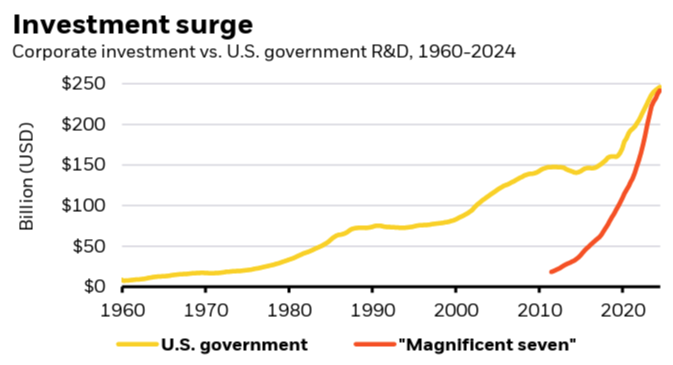
Source: Blackrock, February 3, 2025.9
Diversify
The DeepSeek lesson was a powerful reminder of the necessity of diversification, especially in the context of a concentrated S&P 500. Though 70% of the companies in the S&P 500 finished Monday, January 27th, with stock prices up from the opening bell, the index itself fell by 1.5%.10 Currently, 32% of the of the S&P 500’s market cap is found in the Magnificent 7, and another 19% comes from other technology companies.11 With such a concentration in specific companies and sectors, volatility may very well be the rule as opposed to the exception. Though the S&P is composed of 500 companies, it cannot be considered diversified in and of itself.
Tariffs
The markets were volatile earlier this week as tariffs between the United States, Mexico, and Canada were top of mind. The United States and China also imposed tariffs on each other, though that caused less price action as it was almost certainly viewed as a foregone conclusion compared to the relative surprises with Mexico and Canada. The United States agreed with Canada and Mexico to postpone implementation of the tariffs until March 4. It remains to be seen whether those tariffs will ever actually be implemented, but general consensus is that they are more likely to be held in reserve for leverage.12 Regardless, there is likely to be continued volatility surrounding the potential implementation of tariff plans amplified by the very fact that they are negotiating tools. The market reacted the way it did on Monday largely because investors were skeptical that the tariffs would actually be enacted. As the proposed start time drew nearer, a small selloff took shape. With news of an agreement with Mexico, followed by an agreement with Canada, the market recovered its intraday loss in its entirety. We expect this to potentially repeat with future tariff events.
Citations:
1. BlackRock. Is the Deep Sink in AI Stocks from DeepSeek Warranted? BlackRock, January 31, 2025.
2. Mok, C. Taking Stock of the DeepSeek Shock. The Freeman Spogli Institute Cyber Policy Center at Stanford University, February 5, 2025.
3. IBID.
4. Boivin, J et al. Weekly Commentary. BlackRock, February 3, 2025.
5. Heim, L. The Rise of DeepSeek: What the Headlines Miss. The Rand Institute, January 28, 2025.
6. BlackRock. Is the Deep Sink in AI Stocks from DeepSeek Warranted? BlackRock, January 31, 2025.
7. Boivin, J et al. Weekly Commentary. BlackRock, February 3, 2025.
8. Gallagher, D. Amazon Pours Fuel on Big Tech Spending After DeepSeek Panic. The Wall Street Journal, February 7, 2025.
9. Boivin, J et al. Weekly Commentary. BlackRock, February 3, 2025.
10. J.P. Morgan Asset Management. Weekly Market Recap. J.P. Morgan Asset Management, February 3, 2025.
11. IBID.
12. Hatzius, J. et al. Rethinking Tariffs. Goldman Sachs, February 4, 2025.
Important Information
The Clifford Group LLC (“The Clifford Group”) is a registered investment advisor. Advisory services are only offered to clients or prospective clients where The Clifford Group and its representatives are properly licensed or exempt from licensure. The information provided is for educational and informational purposes only and does not constitute investment advice and it should not be relied on as such. It should not be considered a solicitation to buy or an offer to sell a security. It does not take into account any investor’s particular investment objectives, strategies, tax status or investment horizon. You should consult your attorney or tax advisor. The views expressed in this commentary are subject to change based on market and other conditions. These documents may contain certain statements that may be deemed forward looking statements. Please note that any such statements are not guarantees of any future performance and actual results or developments may differ materially from those projected. Any projections, market outlooks, or estimates are based upon certain assumptions and should not be construed as indicative of actual events that will occur. All information has been obtained from sources believed to be reliable, but its accuracy is not guaranteed. There is no representation or warranty as to the current accuracy, reliability, or completeness of, nor liability for, decisions based on such information and it should not be relied on as such. The information contained above is for illustrative purposes only.
For additional information, please visit our website at www.thecliffordgrp.com
Risk Disclosure
No investment strategy or risk management technique can guarantee returns or eliminate risk in any market environment. All investments include a risk of loss that clients should be prepared to bear. The principal risks of The Clifford Group strategies are disclosed in the publicly available Form ADV Part 2A. Diversification does not ensure a profit or guarantee against loss. Risk associated with equity investing include stock values which may fluctuate in response to the activities of individual companies and general market and economic conditions.